HOIMask: Towards Generative Masked Modeling for Human Object Interaction Generation
Abstract
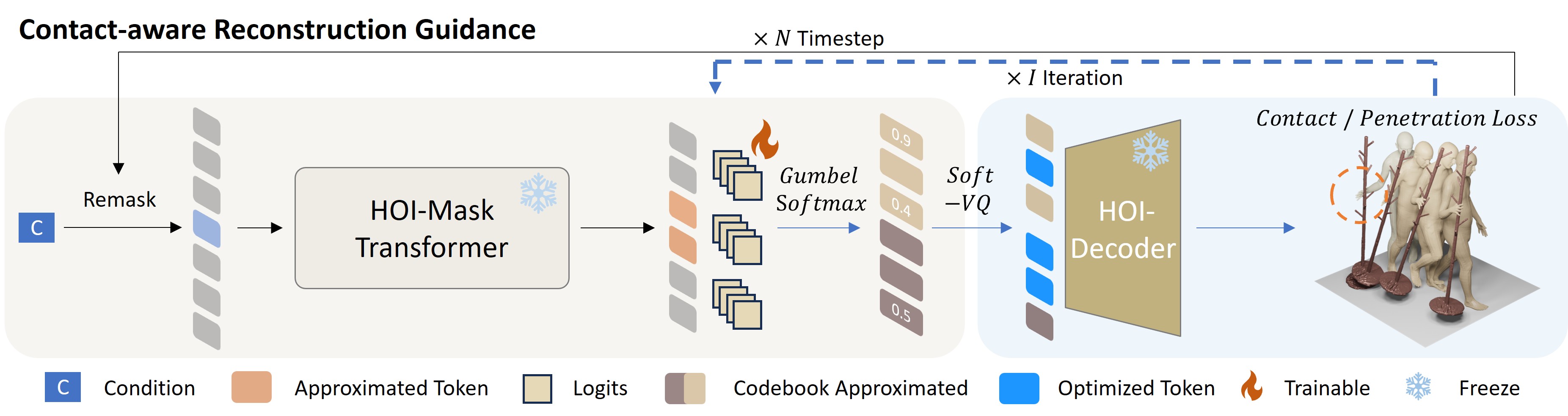
Diffusion-based methods have dominated the human-object interaction (HOI) generation, as they enable critical contact fusions or signals to guide the diffusion process. However, they often result in high artifacts and unstable interaction quality due to error accumulation during iterative denoising. In this work, we propose HOIMask, the first generative masked framework for modeling HOI motion in discrete space. HOIMask first encodes both motion sequences and contact-aware signals into discrete 2D human and object token maps via a HOI VQ-VAE, preserving fine-grained spatial-temporal structure beyond conventional 1D representations. On this basis, a generative masked modeling framework is employed to jointly capture human-object interaction dynamics, leveraging a transformer architecture designed to model complex spatial-temporal and interaction dependencies. To generate more coherent and physically plausible motions, we further introduce a novel Contact-aware Reconstruction Guidance in discrete space during inference, which fuses contact signals to optimize HOI tokens that forces the generated motion with higher spatio-temporal consistency. With craftily designed motion interaction tokens, dedicated architecture and guidance strategy, HOIMask significantly outperforms state-of-the-art diffusion-based methods, generating more realistic and semantically aligned HOI motions.
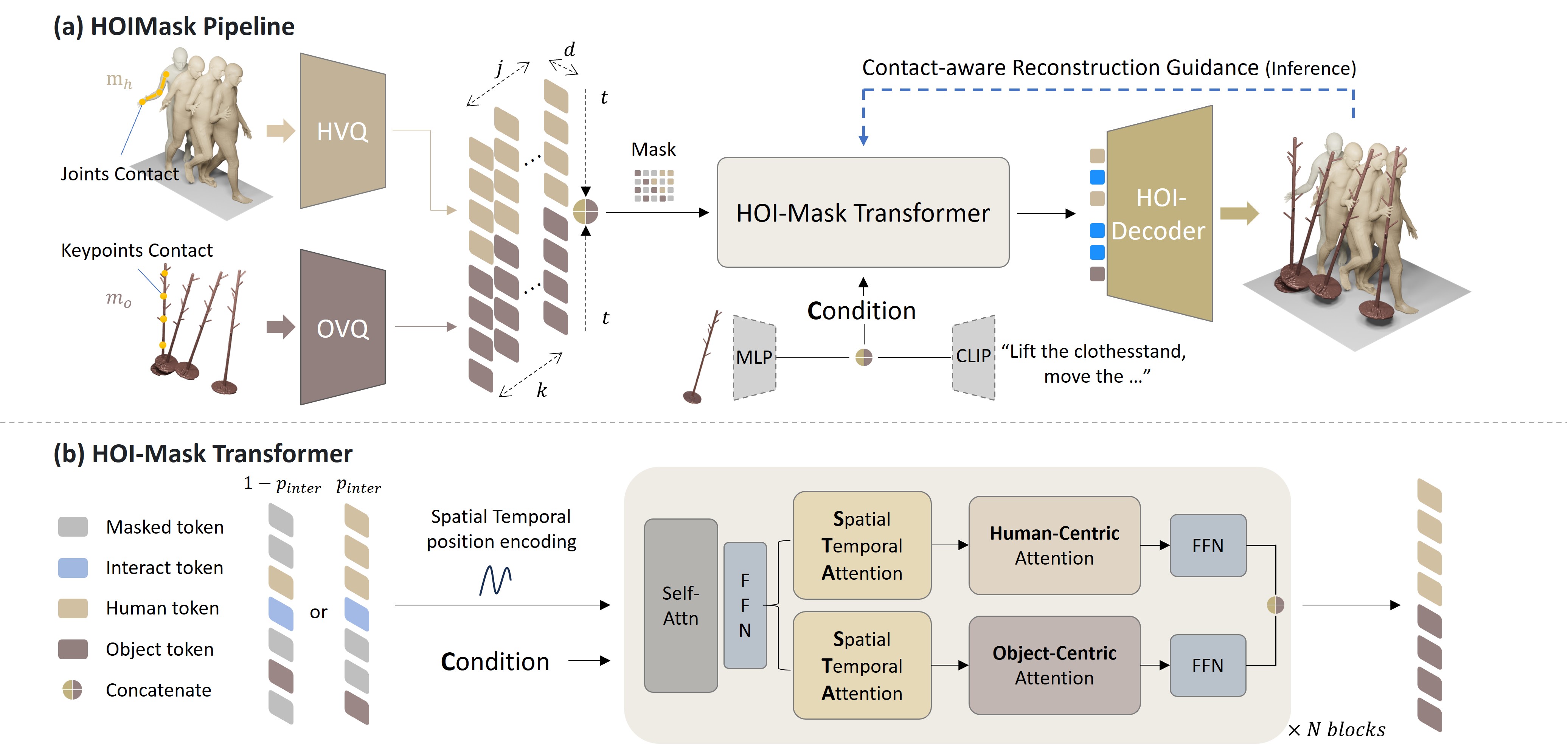
Method Overview. (a) During training, HOI motions first are quantized via HVQ and OVQ into 2D HOI tokens, which are partially masked and predicted by the HOI-Mask Transformer. During inference, the HOI tokens are optimized with Contact-aware Reconstruction Guidance to generate more physically plausible interactions through HOI-Decoder. (b) The HOI-Mask Transformer incorporates Spatial-Temporal Attention and Human/Object-Centric Attention to model fine-grained spatio-temporal dependencies.